

MASTER in Chemistry
Student Feedback
Student Publication
STUDENT FEEDBACK RESULT
| Course | Credit | Lecture/Exam Hours | Independent Study Hours | Assignment Hours | Exam Preparation Hours | Miscellaneous Hours |
|---|---|---|---|---|---|---|
| Bioactivity of Secondary Metabolites | 3 | 40 | 64 | 24 | 6 | 1 |
| Bioinformatics | 2 | 26.72 | 42 | 18 | 2 | 1 |
| Biomembranes and Signal Transduction | 2 | 26.72 | 42 | 18 | 2 | 2 |
| Biosynthesis of Secondary Metabolites | 3 | 40 | 56 | 36 | 2 | 2 |
| Biotransformation of Organic Compounds | 2 | 26.72 | 28 | 30 | 4 | 1 |
| Structure Elucidation | 3 | 40 | 28 | 60 | 4 | 3 |
| Molecular Structure Elucidation of Secondary Metabolites | 3 | 40 | 42 | 48 | 3 | 2 |
| Material and Energy Chemistry | 2 | 26.72 | 28 | 32 | 2 | 2 |
| Enzymology | 2 | 26.72 | 28 | 30 | 4 | 2 |
| Immunomodulators and Vaccine Development | 2 | 26.72 | 28 | 28 | 4 | 4 |
| Selected Topics in Organic Chemistry | 3 | 40 | 42 | 48 | 4 | 2 |
| Advanced Physical Organic Chemistry | 2 | 26.72 | 28 | 32 | 3 | 1 |
| Advanced Synthetic Organic Chemistry | 3 | 40 | 42 | 48 | 3 | 2 |
| Molecular Mechanisms of Diseases | 2 | 26.72 | 28 | 28 | 4 | 3 |
| Advanced Chemical Separation and Analytical Techniques | 3 | 40 | 42 | 48 | 3 | 2 |
| Biochemical Research Techniques | 3 | 40 | 42 | 48 | 3 | 3 |
PROFILE
Vision
To become a master of chemistry study program that is excellent in the field of biological and non-biological natural products and environmental chemistry at the national and regional levels in 2020 and internationally recognized in 2025.
Mission
- To conduct and to organize the high quality and competitive education for master programs of chemistry in the field of biological and non-biological natural products and environmental chemistry.
- To conduct the research in the field of multidisciplinary research of chemistry including biological and non-biological natural products and environmental chemistry aiming for the advance development of science and technology and public welfare.
- To conduct research and publication collaborations with domestic and foreign institutions.
Objective
- Formation and character development of masters of chemistry who master the concepts of chemistry and apply them to the utilization of natural resources and the environment through independent research.
- Increasing multidisciplinary research products in the form of scientific publications and/or patents in the field of natural products (biological and non-biological) and the environment that can be used for the development of science and technology and public welfare.
- Improving the quality and quantity of research and publication collaboration with domestic and foreign institutions.
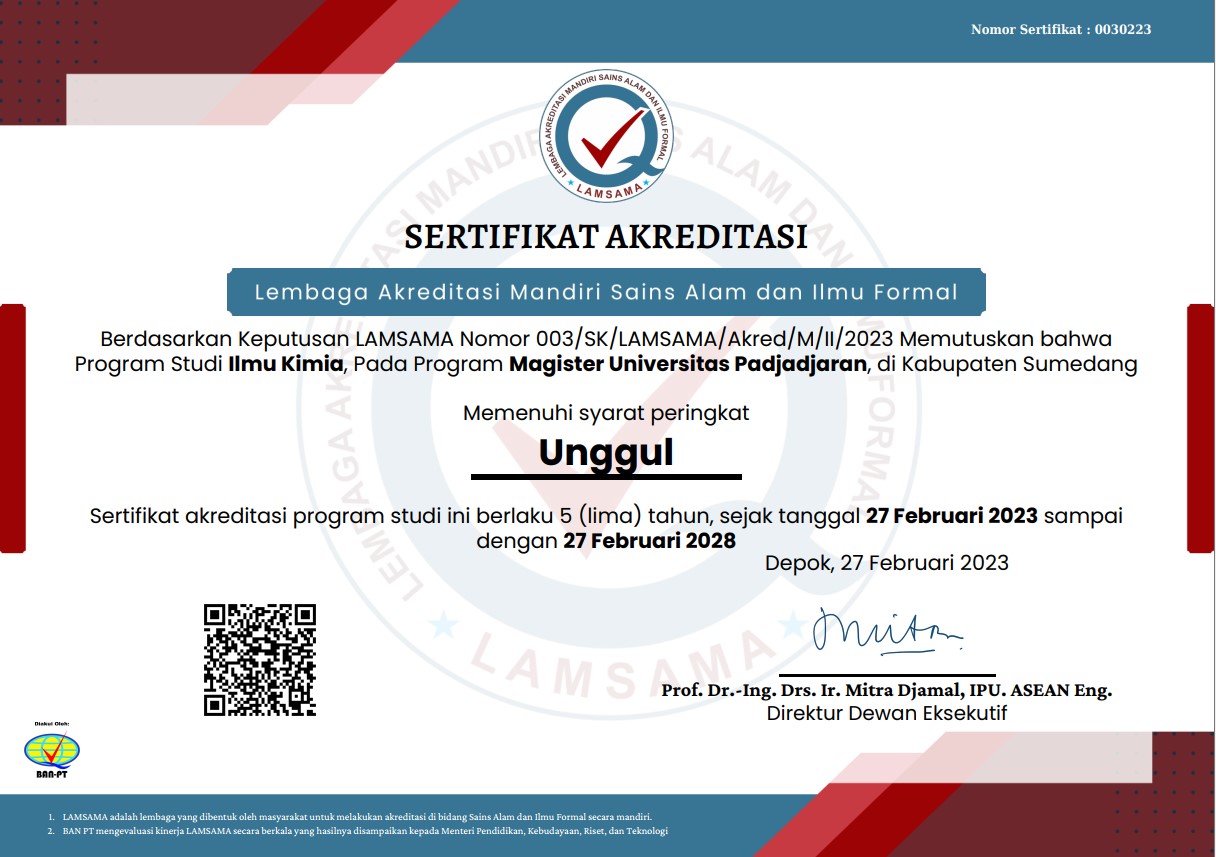
 |
 |
|
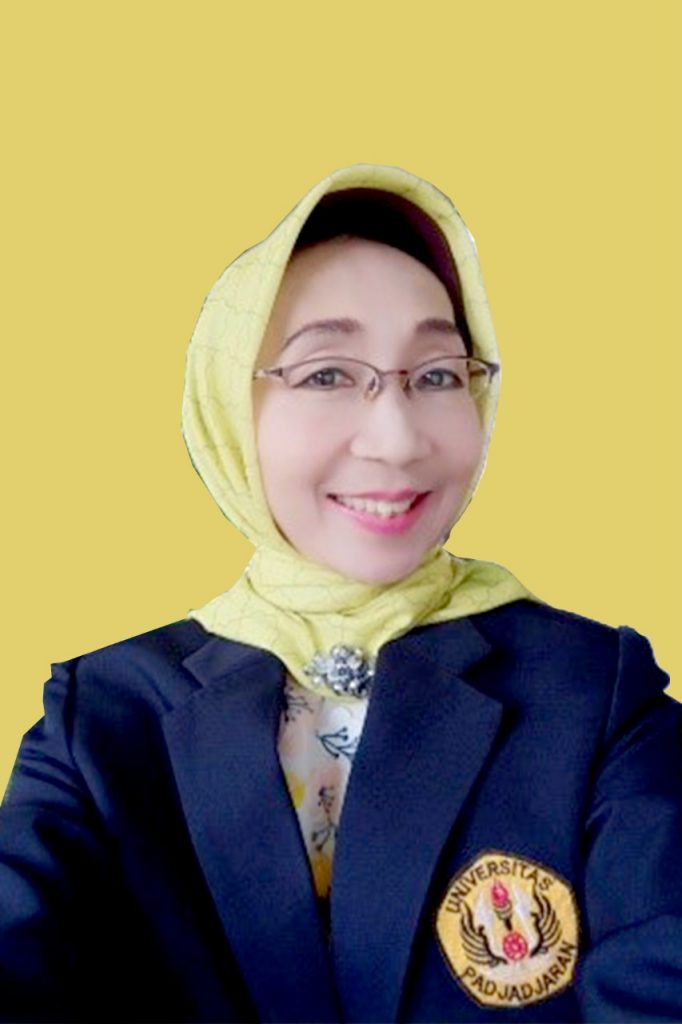
| Head of Master Degree Program Dr. Tati Herlina, M.Si. NIP: 196203201988032001 e-mail: [email protected] |
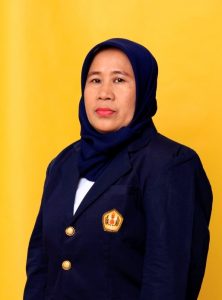
Secretary of Master Degree Program Ai Rohayati e-mail: [email protected] |
| No | Lecturer | NIP (EMPLOYEE ID NUMBER) |
| 1 | Prof. Dr. Iman Rahayu | 19690208 199412 1 001 |
| 2 | Prof. Dr. Toto Subroto | 19590901 198702 1 001 |
| 3 | Prof. Dr. Husein H. Bahti | 19480419 197310 1 001 |
| 4 | Prof. Rani Maharani, Ph.D. | 19810114 200604 2 002 |
| 5 | Prof. Dr. Yeni Wahyuni Hartati | 19710924 199802 2 001 |
| 6 | Prof. Dr. R. Ukun M.S. Soedjanaatmadja | 19521028 202302 3 001 |
| 7 | Prof. Dr. Atiek Rostika | 19711111 199903 2 001 |
| 8 | Prof. Dr. Iman Permana Maksum | 19710713 199702 1 001 |
| 9 | Prof. Dr. Unang Supratman | 19660704 199101 1 001 |
| 10 | Prof. Dr. Tati Herlina | 19620320 198803 2 001 |
| 11 | Prof. Dr. Euis Julaeha | 19620320 198803 2 001 |
| 12 | 19740411 199803 2 001 | |
| 13 | Dr. Shabarni G. | 19710425 200501 2 001 |
| 14 | Dr. eng. Irwan Kurnia | 19870118 202109 3 001 |
| 15 | Ari Hardianto, PhD | 19870523 201903 1 014 |
| 16 | Juliandri, PhD | 19690717 199802 1 002 |
| 17 | Dr. rer. nat. Yudha Prawira Budiman | 19890629 201604 3 001 |
Find us at:
D5 Building
Jatinangor, Sumedang Regency, West Java 45363
Indonesia
e-mail: [email protected]
phone & fax: +62 22 7794391
FACILITIES
Chemistry Dept. Laboratories
Central Laboratories
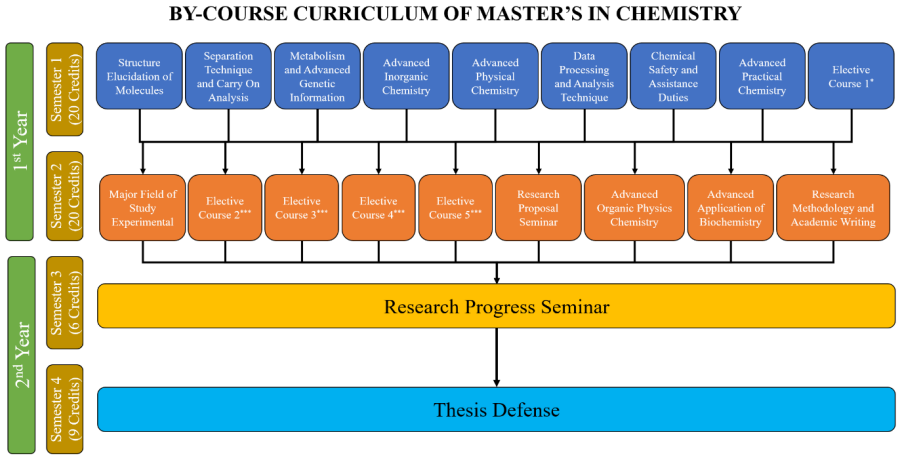
CURRICULUM
| PLO-1 | Formation and character development of masters of chemistry who master the concepts of chemistry and apply them to the utilization of natural resources and the environment through independent research. |
| PLO-2 | Increasing multidisciplinary research products in the form of scientific publications and/or patents in the field of natural products (biological and non-biological) and the environment that can be used for the development of science and technology and public welfare. |
| PLO-3 | Improving the quality and quantity of research and publication collaboration with domestic and foreign institutions. |
| ILO-1 | internalize academic values, norms, and ethics. |
| ILO-2 | honest, disciplined, responsible, able to work together, respect the work of others and uphold scientific ethics. |
| ILO-3 | Mastering the theoretical concepts of isolation, synthesis and/or characterization of biological and non-biological chemicals and environmental chemistry. |
| ILO-4 | Mastering basic operational knowledge of instruments and/or software for data analysis and processing in the field of chemistry. |
| ILO-5 | mastering the principles of chemical safety and security |
| ILO-6 | able to apply logical, critical, systematic, and innovative thinking in the context of the development or implementation of science and technology. |
| ILO-7 | able to demonstrate independent, quality, and measurable performance |
| ILO-8 | able to collect and communicate research results. |
| ILO-9 | able to be responsible for the achievement of group work results, supervise and evaluate the completion of work assigned to workers who are under their responsibility |
| ILO-10 | able to carry out self-evaluation process of work groups under their responsibility and able to manage learning independently |
| ILO-11 | able to use instruments for isolation, characterization and/or synthesis of biological and non-biological chemicals as well as environmental chemistry. |
| ILO-12 | able to process data using software for molecular characterization or modeling. |
| ILO-13 | able to carry out work and handle hazardous chemicals in accordance with occupational health and safety standards; |
| ILO-14 | able to document, store, secure, and retrieve data to ensure its validity and prevent plagiarism as well as being able to communicate it orally and in writing. |
Course Modules
Please click the semester toggles below to access the course modules
Semester #1
Semester #2
Semester #3
Semester #4
Elective Course
Research Project in Food Biochemistry
Research Project in Health Biochemistry
Advanced Organic Synthesis Chemistry
Bioactive secondary metabolites
Techniques in Synthetic Organic Research
Biomembrane, Transport and Signal Transduction
Food Biochemistry Research Techniques
Immunomodulator and Vaccine Development
SERVICES
Libraries
We have a university library for all Unpad Students and Staffs located at Grha Kandaga, which can also be accessed online over http://kandaga.unpad.ac.id or https://login.unpad.idm.oclc.org/menu. Additionally, students have access directly to Faculty Library at D6 Building Floor 2 & 3.
- Central library
- Faculty library
- Online National Library (PNRI)
ICT
Information System For Administrative Purposes
Office Information System (e-Office)
Employee Performance Information System (KKID)
System Authentication Information System (PAUS-ID)
Lecturer Information System (Staffs)
Student Information System (PACIS)
Information Systems for Learning and Research Activities
Learning Information System (LIVE)
Library Repository Information System (Kandaga)